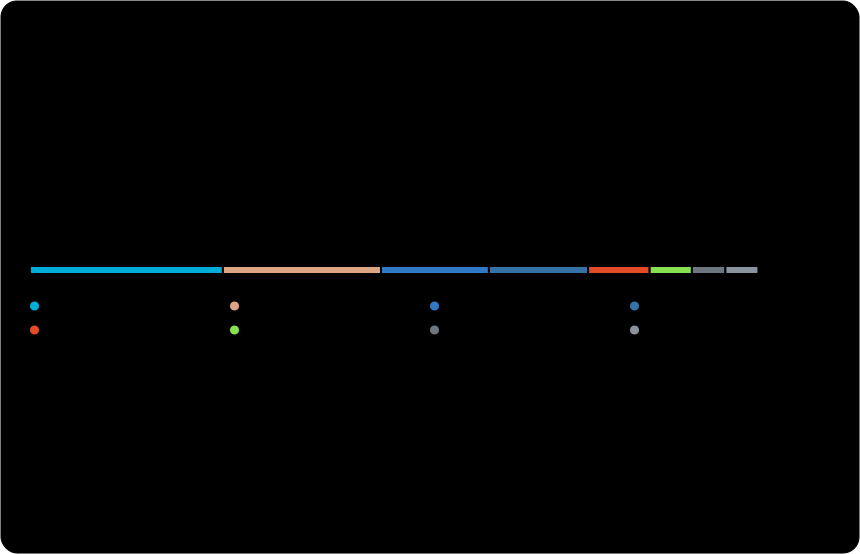




That's Eulix parsing the Linux kernel.
I build software for people who have to understand systems that are too large to keep in their head.


I'm Nurysso, a systems engineer interested in compilers, code analysis, developer tooling, and software that has to deal with reality rather than toy examples or basic curds 🍛.
I care about correctness, performance, and understanding what's actually happening underneath the abstraction.
Current masterpiece of work
Open-source · Local-first · Polyglot · Apache-2.0 Most code retrieval systems treat a repository like a collection of documents. Eulix treats it like a program.
Ask a coding agent about code it has never seen and it greps, opens a file, greps again and backs out of dead ends, and every step piles up in its context window.
Eulix parses the repo once into symbols, scopes and a call graph, keeps that index warm in a local MCP server, and answers each question with one ranked reply that fits a token budget, every chunk tagged with its file:line.
your repo
    ↓
PRISM    call graph from the syntax tree   (Rust · Tree-sitter)
    ↓
EHNAS    ranked context, no model in loop (Go)
    ↓
MCP      Claude Code · Cursor · Windsurf · Cline · …
Instead of throwing a huge pile of text at an LLM and hoping it figures out the architecture, Eulix tries to determine which code actually matters first. That's the interesting part.
Polyglot Resolution via Inverted Symbol Maps PRISM v2 resolves calls straight from the syntax tree across nine languages, with no build step and no type checker. Checked against each language's own compiler tooling, 98.6% of the call edges it draws are right. When a name is too ambiguous to guess, it leaves the edge out, because a missing edge misleads less than a wrong one.
Retrieval with zero embeddings, zero GPU, zero network. Exact matches, Monte Carlo walks over the call graph and cross-language twin search, packed to fit the token budget. Want semantic recall too? The ETIYA engine adds embeddings on top.
| 98.6% | < 20 ms | < 90 MB | 53.9 s |
|---|---|---|---|
| precise call edges | warm query (p50) | MCP server memory | Linux kernel parsed, call graph and all |
Everything runs on your machine: no account, no API key, no telemetry. → Explore Eulix
rmwith an undo button.
A reversible file-deletion TUI built with Go and Bubble Tea. Because deleting the wrong directory shouldn't require a backup strategy.
Your filesystem, locally classified.
A file organiser using local ML inference to classify and move files without sending them to the cloud.
Hyprland configuration with opinions.
A Hyprland configuration that adapts itself to aesthetic preferences during installation.
systems
├── compilers & parsers
├── static analysis
├── code intelligence
├── developer tooling
├── local inference
└── Linux
And occasionally things that exist purely because they seemed fun to build.
Rust · Go · TypeScript · Python · Bun
Linux · MySQL · MariaDB
I'm open to remote or on-site opportunities across EMEA / APAC. I'm particularly interested in teams working on:
- systems software
- developer infrastructure
- compilers / language tooling
- static analysis
- large-scale developer platforms
- performance-critical software
If your codebase is large, messy, old, fast-moving, or all four — that's usually where I want to be.
Email: nurysso [at] proton.me
Discord: nurysso