
简体中文 | English


Adaptive request timeouts calculated from an Exponential Moving Average (EMA) of observed response times.
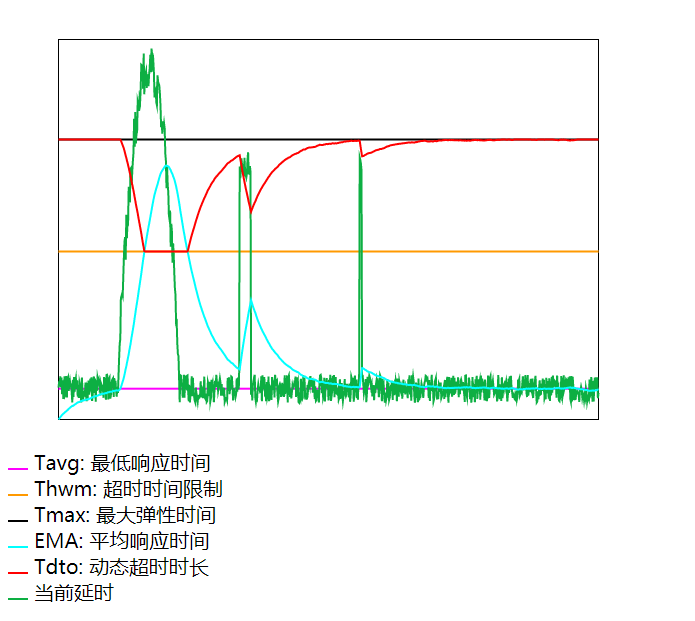
EMA is usually used in finance to predict the next period from historical data. This library adapts the idea to timeout control by introducing an "average effect": instead of requiring every request to finish within a fixed timeout, it uses the average response time as the health signal. The design goals are:
- the overall service level must not be exceeded;
- the better the average behaviour, the more headroom ("elasticity") is granted to individual slow requests;
- the worse the average behaviour, the smaller that headroom — failures are detected faster so graceful degradation can kick in.
Here elasticity means the maximum response time a spike is allowed to consume.
- Zero dependencies, single file, pure CommonJS, no timers or I/O.
- Validated configuration, read-only derived state, explicit bounds clamping.
- No cold-start bias: the first sample seeds the EMA directly.
reset(),configure()andtoJSON()for warm starts, live tuning and observability.- Handwritten TypeScript declarations and an assertion-based test suite.
npm i ema-timeout --saveconst ema = require('ema-timeout');create(options) holds an EMA value ema (initial 0), a sample counter, and a smoothing factor
[ r = \frac{2}{N + 1}, \qquad ema \leftarrow x \cdot r + ema \cdot (1 - r) ]
where x is the latest observed latency in milliseconds. The first sample seeds the EMA directly (ema = x), so the recommended timeout reflects reality from the very first request instead of staying at Tmax for ~N requests.
get() maps that EMA to a timeout:
| Condition | Result | Meaning |
|---|---|---|
ema <= Tavg |
Tmax |
Health is better than the baseline: grant the maximum elasticity. |
ema >= Thwm |
Thwm |
Latency is consistently bad: clamp to the high-water mark and fail fast. |
| otherwise | Thwm + p * (Tmax - Thwm), where p = (Thwm - ema) / (Thwm - Tavg) |
Linear interpolation between the two bounds. |
The result is explicitly clamped to [0, Tmax]. Configuration is validated so Tmax >= Thwm > Tavg >= 0 and N >= 1, which keeps the interpolation interval well-defined.
Creates an independent timeout calculator. options is a plain object; null/undefined values fall back to defaults, and the caller's object is never modified. Invalid values throw TypeError / RangeError.
| Option | Default | Unit | Description |
|---|---|---|---|
Tavg |
60 |
ms | Baseline response time; in practice the measured average response time. Must be >= 0. |
Thwm |
250 |
ms | High-water mark / timeout ceiling. Must be > Tavg. |
Tmax |
500 |
ms | Maximum elastic time granted when the service is healthy. Must be >= Thwm. |
N |
80 |
samples | Smoothing window. Must be >= 1. Smaller values weight recent samples more heavily; larger values react more slowly and take longer to converge. |
Returns a calculator with read-only getters and methods:
| Member | Type | Description |
|---|---|---|
options |
Readonly<EmaOptions> |
Frozen, validated configuration. Assigning to any derived field throws TypeError at runtime; use reset() / configure(). |
ema |
number |
Current EMA (ms). |
r |
number |
2 / (N + 1), recomputed when configuration changes. |
samples |
number |
Samples fed since creation / last reset(). |
update(x) |
(number) => number |
Feed a latency sample, return the new EMA. |
get() |
() => number |
Recommended timeout in ms, clamped to [0, Tmax]. |
reset(initialEma?) |
(number?) => void |
Clear the running average, or warm-start it from a known EMA. |
configure(patch) |
(Partial<EmaOptions>) => Readonly<EmaOptions> |
Validate and apply a partial configuration update. |
toJSON() |
() => EmaSnapshot |
{ options, ema, samples } for persistence / logging. |
Feed the elapsed time of the most recent request, in milliseconds. x must be a finite, non-negative number; NaN, strings, undefined and negative values throw instead of corrupting the EMA. Call it on every request, successful or not. For a timed-out request the sample should reflect at least the timeout you allowed:
emaObj.update(Math.max(Date.now() - start, options.Tmax));Return the currently recommended timeout. Call it just before issuing the request and pass the value as the request timeout.
| Export | Description |
|---|---|
create(options?) |
Calculator factory. |
DEFAULTS |
Frozen defaults { Tavg: 60, Thwm: 250, Tmax: 500, N: 80 }. |
validateConfig(config) |
Validate a full configuration up front (throws on invalid values). |
Create one instance per backend endpoint (or per dependency), because latency profiles differ:
const ema = require('ema-timeout');

const options = {
  Tavg: 55,   // baseline / average response time (ms)
  Thwm: 300,  // timeout ceiling (ms)
  Tmax: 500,  // maximum elastic time (ms)
  N: 90       // smoothing window
};
const emaObj = ema.create(options);
const start = Date.now();
const tdto = emaObj.get(); // recommended timeout for this request
try {
const result = await request({ timeout: tdto }); // your business request
emaObj.update(Date.now() - start);
} catch (e) {
// treat a failure as at least Tmax, so the EMA reflects service health
emaObj.update(Math.max(Date.now() - start, options.Tmax));
}Live tuning and warm starts:
emaObj.configure({ N: 40 });      // react faster from now on
emaObj.reset(120);                // warm-start from a known average
console.log(emaObj.toJSON()); // { options, ema, samples }index.d.ts is shipped and declared through types / exports; no @types package is needed.
import { create, DEFAULTS, validateConfig, type EmaOptions, type EmaTimeout } from 'ema-timeout';

const options: Partial<EmaOptions> = { Tavg: 55, Thwm: 300, Tmax: 500, N: 90 };
validateConfig({ ...DEFAULTS, ...options });

const calc: EmaTimeout = create(options);
const timeout: number = calc.get();
calc.update(42);EmaOptions, EmaSnapshot, EmaTimeout and Readonly<EmaOptions> are exported; derived state is typed as read-only, so accidental writes are a compile error.
- Fixed business logic executed in a loop (e.g. FastCGI / S++ style services).
- The process spends most of its time waiting for responses, not doing CPU work or I/O interrupts.
- Serial request handling, where a single slow or anomalous request blocks everything behind it.
- Response-time distribution that does not fluctuate wildly.
- Graceful degradation / lossy service is acceptable.
It is a poor fit for CPU-bound jobs, highly bimodal latency distributions, or situations where every single request must meet a hard deadline — use a fixed timeout in those cases.
Tavgshould come from steady-state measurements, not from a guess.Thwmis the hard ceiling: how long you can afford to wait in the worst case.Tmaxis only reached while the EMA is healthy; setting it far aboveThwmincreases the cost of individual spikes.Ncontrols the trade-off between smoothness and reaction speed. Usereset(knownAverage)when you already have historical data.
- Breaking change vs 1.0.x: invalid configurations and invalid samples now throw instead of silently producing
NaN;Tmax >= Thwm > Tavg >= 0andN >= 1are enforced. Review existing configuration before upgrading. - First sample seeding: the first
update(x)setsema = x(instead ofx * r). This removes cold-start bias but makes the very first timeout react immediately to a single outlier. Usereset(knownAverage)if that is undesirable. - Minimal model: a plain EMA only — no percentiles, variance, outlier rejection, sample cap or retry/backoff policy. It does not distinguish timeouts from successes; the caller must encode that in the sample value.
- Runtime format: CommonJS only (TypeScript declarations are provided, but there is no ESM bundle).
- Chart page:
test/index.htmlis a visualisation, not a test runner;npm testruns the assertion suite intest/index.js(15 checks).
| Path | Purpose |
|---|---|
index.js |
create() and helpers |
index.d.ts |
Handwritten TypeScript declarations |
test/index.js |
Assertion-based test suite (npm test) |
test/index.html |
Interactive chart (GitHub Pages) |
npm test # node ./test/index.js — 15 assertion checks, no external dependenciesMIT © jiamao